 Arbitrum docs
Arbitrum introduction
Frequently asked questions about Arbitrum, a finance-native blockchain platform.
What is Arbitrum?
Arbitrum is a finance-native blockchain platform. It provides infrastructure for applications, tokenization, and dedicated blockchain environments.
You can build on the public chains Arbitrum One and Arbitrum Nova, or you can launch your own and configure its execution, data availability, fee model, governance, and validation.
Arbitrum runs on top of Ethereum. Your transactions cost less and the chain processes more of them per second, while Ethereum still settles the results and keeps the data available. This page explains the main parts of the platform: Arbitrum Rollup, AnyTrust, Nitro, Stylus, Arbitrum One, Arbitrum Nova, and Arbitrum chains.

Two pairs of names appear throughout this page. Ethereum is the , also called . An Arbitrum chain that settles to Ethereum is a , also called .
Why does Ethereum need help scaling?
Nothing is wrong with Ethereum. Its limits follow from design choices that put decentralization and security first.
That tradeoff is the scalability trilemma: a chain cannot maximize decentralization, security, and scalability at the same time. Ethereum optimizes the first two, which caps the third.
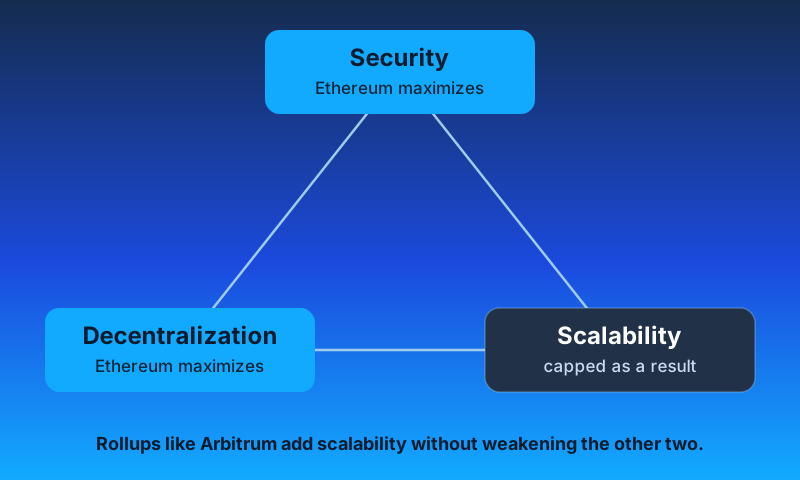
Rather than weaken security or decentralization, the Ethereum roadmap moves execution offchain to Rollups like Arbitrum. Ethereum then specializes in settlement and data availability.
A Rollup orders many transactions into a , executes them on its own infrastructure, and posts compressed data and a state commitment back to Ethereum. You inherit Ethereum's security, throughput rises by orders of magnitude, and fees drop.
To go deeper, read How Arbitrum works.
Why does Ethereum process so few transactions per second?
Ethereum's low throughput follows from the protocol design. It is not a bug or a missing optimization.
Ethereum nodes must agree on the current state, and they reach that agreement by having every node process every transaction.
Ethereum is also an open, decentralized, peer-to-peer system, so anyone can run a node and validate the chain. Keeping that possible means keeping the work per node small.
Together, these two requirements cap transactions per second (TPS). The roadmap answers this by having child chains like Arbitrum carry the throughput.
How does Arbitrum solve this?
Arbitrum does not make Ethereum faster. It lets you transact at much higher throughput while you still inherit Ethereum's security.
Ethereum's bottleneck is that every node re-executes every transaction. Arbitrum separates two jobs that Ethereum combines:
- Execution. Running transactions and updating state.
- Settlement and data availability. Agreeing on the canonical result and keeping the data publicly retrievable.
Arbitrum executes offchain and uses Ethereum for settlement and data availability. Ethereum nodes do not re-execute Arbitrum transactions. They store the compressed data and accept the result unless someone proves it wrong.
How does Arbitrum prove that a result is correct?
When a transaction reaches Arbitrum, the puts it in order. Arbitrum compresses that order and posts it to Ethereum. The posted order is the evidence of which transactions run, and that is where the name "Rollup" comes from.
As long as Ethereum stays secure, anyone can read those transactions. If a result differs from the posted order, a can challenge it.
Billions of dollars have moved through Arbitrum, and no fraudulent result has ever been confirmed.
To learn how the dispute protocol works, read the BoLD gentle introduction.
Who validates the chain and raises challenges?
Anyone can validate Arbitrum's . Whoever does so is a validator. Most people do not run one, in the same way that most people do not run an Ethereum staking node.
The system needs only one honest validator to keep the chain secure, and that single validator can catch several malicious actors. This is what makes the system trustless: your funds do not depend on any one designated party.
To learn about the validator types, read Run a validator node.
How does a fraud proof work?
In short: two validators disagree about an executed transaction. Ethereum holds the posted data, so only one of them can be telling the truth.
Re-executing every transaction on Ethereum would cost too much. Instead, each party bisects its history of commitments until both arrive at the single instruction they disagree about.
Ethereum then acts as the arbiter and declares a winner. The batches that Arbitrum posts to Ethereum are the source of truth, and the challenge process, called , proves which validator is right.
For the full protocol, read the BoLD gentle introduction.
Does the challenge period delay my transactions?
There is a delay, but it applies to one action, not to everyday activity.
| Action | Delay |
|---|---|
| Withdraw funds from Arbitrum to Ethereum | Yes, typically 6.4 days |
| Use a third-party fast bridge | No, for a fee |
| Deposit funds from Ethereum to Arbitrum | No |
The delays withdrawals back to Ethereum because that is the point where you cross a trust boundary. It does not affect the transactions you send inside Arbitrum.
To learn how bridging works, read Token bridging. To move tokens yourself, follow the Arbitrum bridge quickstart.
Why are fees on Arbitrum lower?
The word "optimistic" describes how Arbitrum verifies state: it treats an as valid unless someone challenges it through BoLD. That design buys security and correctness rather than cost savings.
The low fees come from five other things:
- Amortized Ethereum costs. Arbitrum posts transactions in batches. A batch of 500 transactions spreads one posting cost across all 500.
- Compression. Arbitrum compresses the data it posts, so each batch costs less.
- Blobs. EIP-4844 gives Ethereum a separate data lane, priced independently of regular gas, that makes posting batch data cheaper.
- No global re-execution. Ethereum nodes do not re-execute Arbitrum transactions.
- Single-sequencer execution. One sequencer is active at a time, so computation runs on one machine instead of thousands.
To go deeper, read How Arbitrum works.
Is using Arbitrum the same as using Ethereum?
In short: yes, at lower cost and higher speed. You bridge funds in, use applications, and bridge funds out. Your wallets, applications, and addresses all work.
Layer 2 protocols optimize for different goals. Arbitrum put Ethereum compatibility first, so you can use your existing Ethereum wallets, and you can build and deploy contracts with your existing Ethereum libraries and tooling.
Arbitrum reaches that compatibility by running a fork of Geth, the most widely used Ethereum implementation, modified to work as a trustless child chain. Most of the code that runs on Arbitrum is the same code that runs on Ethereum. Offchain Labs calls this approach , and you can read the Nitro codebase.
For the differences that remain, read the Comparison overview.
What can you build on Arbitrum that you cannot build on Ethereum?
keeps Nitro's Ethereum compatibility and adds a second virtual machine alongside the Ethereum Virtual Machine (EVM). You can write contracts in Rust, C, and C++, and they interoperate with your Solidity contracts. Stylus shipped in ArbOS 32 and runs on Arbitrum One, Arbitrum Nova, and Arbitrum chains. To try it, follow the Stylus quickstart.
You can also launch your own Arbitrum chain with a custom gas token. For example, your chain can charge gas in USDC. The gas token is one of many settings you control. To see the full list, read the Arbitrum chain introduction.
Does Arbitrum Rollup fit every use case?
Arbitrum Rollup avoids centralization and extra trust assumptions, which makes it a strong default and a net gain for the Ethereum ecosystem.
That decentralization has a price, and not every application needs to pay it. When your security requirements differ, another tool in the Arbitrum suite may fit better, for example an .
What is AnyTrust?
AnyTrust is a different data availability option. It works like an Arbitrum Rollup, which posts data in batches to Ethereum, with one change: a small committee keeps the data available instead. Everything else stays the same.
Because the data stays offchain in the normal case, an AnyTrust chain charges much lower fees. In exchange, AnyTrust does not offer the same decentralization, trustlessness, and permissionless security guarantees as a Rollup.
If someone raises a challenge, the AnyTrust chain reverts to Rollup mode. The security assumption is that at least two members are honest and will provide the data when it is needed.
AnyTrust suits applications that need high throughput and do not need the full decentralization of a Rollup.
To learn more, read the AnyTrust protocol.
How many Arbitrum chains are there?
Many. Running multiple chains in parallel is a core advantage of offchain scaling.
Here is a snapshot of the chains running today:
- On Ethereum, as layer 2:
- Arbitrum One, an that the Arbitrum Foundation operates
- Arbitrum Nova, an that the Arbitrum Foundation operates
- Arbitrum chains that developers launch and operate themselves
- On an EVM layer 2, as :
- Arbitrum chains on Arbitrum One and Arbitrum Nova
- Arbitrum chains on other EVM layer 2 chains
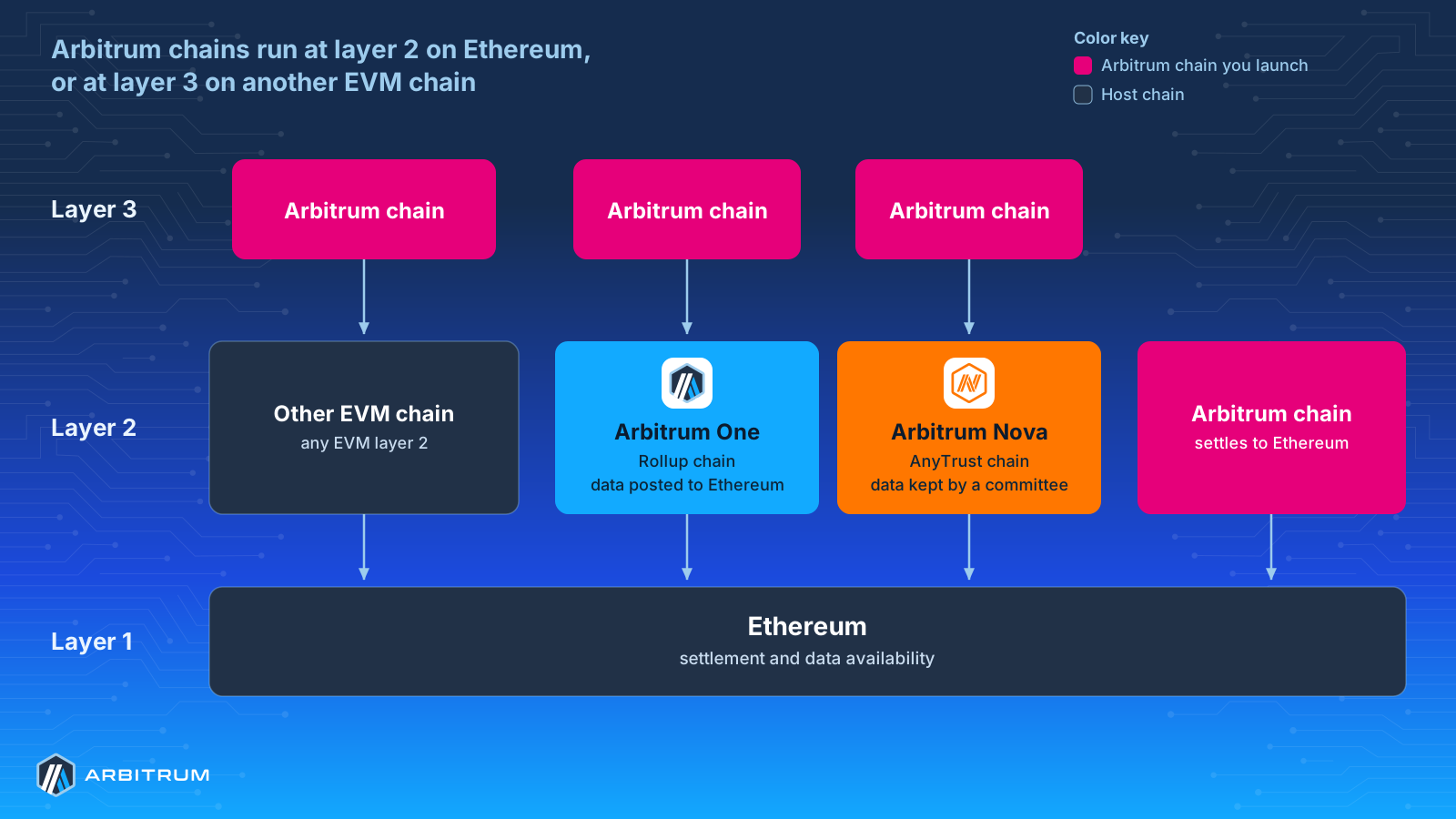
You can launch your own Arbitrum chain as a layer 2 on Ethereum, or as a layer 3 on an EVM layer 2 chain. For a full list of the chains running today, see the Arbitrum Portal.
Pick the chain that matches your security and cost requirements. To launch your own, read the Arbitrum chain introduction.
Who decides the future of Arbitrum?
The Arbitrum governance system owns the Arbitrum chains. To learn how it works, read the Arbitrum governance documentation.
How is this guide?